Status: normative description of format version 1, as written by Pabaru 0.3.
Readers that implement this document can recover every backup Pabaru has ever printed
(see §6.5 for differences between releases).
Purpose. A Pabaru backup is a stack of printed pages. This document describes them
precisely enough that a person with no access to Pabaru, its source code or any of its
dependencies can write an independent decoder, possibly decades from now. A secondary
audience is someone who wants to write a compatible encoder.
Self-containment. This document is complete on its own. References to files in the
Pabaru repository (the test file and the sample page image) are informative: they help
to check an implementation, but nothing normative depends on them. All the data needed
to reproduce the sample backup is printed in §10 and §11.
Test vectors (informative). Every concrete value in this document (hex dumps, tables,
hashes) is computed and checked by crates/pabaru-core/tests/spec_vectors.rs, and the
test fails if a value is missing from this document. That file also
contains an independent reference implementation of the pseudocode below (whitening,
CRC-32C, both Reed–Solomon codes, the shuffle and an ideal page reader). The tests compare
it with the production code and with the reed-solomon-simd library. If you change the
format, the tests fail.
dots ──► cells of a grid with solid grid lines and a thick frame ──► printed pages
Every page also carries at least 4 copies of a superblock, a special block that holds
the backup metadata (k, m, stream length, stream hash, KDF parameters, …). It is
self-describing: one readable superblock copy on any page tells a decoder everything it
needs.
Decoding runs in reverse order:
Locate the dots on a scan and read every cell as 200 bytes.
Undo the whitening, then correct the bytes with the inner Reed–Solomon code and check
the CRC. A cell that fails is simply missing; nothing else needs to know about it.
Group the blocks by backup_id. Take the metadata from a superblock.
Rebuild the missing data shards from any k of the k + m shards using the outer code.
Concatenate the shards, truncate them to the stream length and verify the BLAKE3 hash.
Decrypt the stream if it is encrypted, then decompress it with zstd and unpack the tar.
The key words MUST, MUST NOT, SHOULD and MAY are used as in RFC 2119.
All multi-byte integers are little-endian unless stated otherwise.
Byte offsets and indices start at 0. a ‖ b is concatenation. ⊕ and ^ are XOR.
Ranges.a ..= b is the inclusive range a, a+1, …, b (used in loops and index
sets). a .. b is the half-open range a, …, b−1 (used for slices: X[a .. b] is the
b − a elements starting at a; X[a ..] runs to the end). A range whose end is below
its start is empty. In the pseudocode, for i = x, x+s, x+2s, … < n steps by s while
i < n.
Bit order inside a byte. Bit 0 is the most significant bit (0x80). This is
used only in the bit → dot mapping (§5.5).
Colour. A black (printed) dot is a 1 bit. A white (blank) dot is a 0 bit.
Hex dumps show 16 bytes per line in file order.
⌈a/b⌉ is ceiling division. next_pow2(n) is the smallest power of two ≥ n
(next_pow2(1) = 1).
A dot is the logical unit of the printed grid. One dot is px_per_dot × px_per_dot
printer pixels (§7).
Pabaru writes one zstd frame (level 19 by default, levels 1–22 allowed; the level
does not affect decoding). A reader MUST accept any valid zstd data (RFC 8878).
Flag bit 0 of the superblock (“compressed”, §6.2) is always set by Pabaru. The reference
reader ignores the flag and always decompresses with zstd.
The archive is produced by the Rust crate tar 0.4 with GNU-style headers
(magic = "ustar ", version = " \0", 512-byte blocks). It ends with two all-zero
512-byte blocks. It is not padded to a 10240-byte record.
Entries, in order:
.pabaru/manifest.json – always the first entry. Typeflag NUL (regular file),
mode 0644, mtime 0, uid/gid fields empty (all zero bytes), size = JSON length.
For every root (§2.4) in sorted order: the root itself, then its contents
depth-first. Inside each directory, entries are sorted by file name (byte order of
the OS file name). Each entry is either:
a directory (typeflag 5, size 0, the name has no trailing /), or
a regular file (typeflag 0).
Symbolic links, devices, FIFOs and sockets are skipped and never stored.
Header fields of directory and file entries are copied from the file system: mtime
(seconds since 1970-01-01 UTC), uid, gid and mode. On Unix the mode field contains the
complete st_mode, including the file-type bits (e.g. 0100644 for a regular file).
Readers SHOULD use only mode & 0o7777. The uname/gname fields are empty and device
numbers are 0.
Numeric header fields are normally octal ASCII terminated by NUL or space. In the manifest
entry, however, the uid and gid fields consist of NUL bytes only (no digits at all).
Readers MUST treat an all-NUL (or empty) numeric field as 0. They SHOULD also accept the
GNU base-256 encoding (first byte with the high bit set), which the tar crate uses for
values that do not fit in octal. Only size and the typeflag matter for extraction; the
other fields are metadata.
Long names. A GNU header holds a name of at most 100 bytes and has no ustar prefix
field. For longer names Pabaru (via the tar crate) emits a GNU long-name pseudo-entry
before the real header:
name ././@LongLink, typeflag L;
data = full path bytes followed by one NUL (size = length + 1), padded to 512 bytes.
The real header that follows holds the first 100 bytes of the name, and readers MUST use
the long name instead. A reader SHOULD also accept PAX (x) and GNU K records, since
any standard tar library does.
Path rules.
Paths are relative and use / as the separator. A path MUST NOT be empty, MUST NOT be
absolute (no leading /, no drive letter) and MUST NOT contain . or .. components.
The Pabaru reader rejects such entries and fails the restore (it treats them as an
attack).
Names are UTF-8. Bytes that are not valid UTF-8 on the source system were replaced by
U+FFFD at backup time.
A reader MAY strip a trailing / from directory names. On Windows, readers convert \
to / before checking.
UTF-8 JSON, pretty-printed with two-space indentation (the formatting carries no
meaning). Fields:
Field
Type
Meaning
version
integer
Manifest version, currently 1.
roots
array of objects
The inputs the user selected (files or folders). Each object has name (string), the name of the root inside the archive. The array may be missing in very old manifests; treat a missing array as empty.
files
array of objects
One entry per regular file, in archive order.
files[].path
string
Path inside the archive (same as the tar name).
files[].size
integer
File size in bytes.
files[].blake3
string
BLAKE3-256 of the file content, 64 lowercase hex digits.
Readers MUST ignore unknown fields. Manifests written before Pabaru 0.3 contain an
additional roots[].original field (the absolute source path), which MUST be ignored.
After unpacking, a reader SHOULD verify every files[] entry: the file exists at path
and its BLAKE3 hash equals blake3. Pabaru reports a restore as failed otherwise.
The archive names of the roots are relative to the deepest common ancestor of all
selected inputs. A single input keeps only its own name (hello.txt). Two inputs
/a/x/docs and /a/y/docs become x/docs and y/docs. On Windows, inputs on different
drives have no common ancestor and start with the drive letter (C/work/docs). An input
that lies inside another input is dropped. Absolute source paths are not stored
anywhere in the backup.
Encryption is optional and is indicated by flag bit 1 in the superblock (§6.2).
Without encryption: STREAM = packed.
With encryption: STREAM = nonce (24 B) ‖ ciphertext ‖ tag (16 B), where
ciphertext ‖ tag = XChaCha20-Poly1305-Encrypt(key, nonce, plaintext = packed, aad = "").
This is the “combined” output of the AEAD with the 16-byte Poly1305 tag appended.
Encryption adds exactly 40 bytes.
password = UTF-8 bytes of the password, exactly as typed (no normalisation, no trailing newline),
salt = superblock.kdf_salt (16 bytes),
m = superblock.kdf_mem_kib (memory in KiB),
t = superblock.kdf_iterations (passes),
p = superblock.kdf_parallelism (lanes),
version = 0x13,
secret = empty, associated data = empty,
tag length = 32)
Pabaru’s default parameters are m = 65536 (64 MiB), t = 3, p = 1. The salt and the
nonce come from the operating system’s cryptographic RNG, and both are fresh for every
backup.
The AEAD authenticates the ciphertext only (AAD is empty). The superblock is not
authenticated. A wrong password and a damaged stream both show up as a tag failure; a
reader cannot tell the two apart.
The BLAKE3 stream hash in the superblock (§6.2) is computed over the stored STREAM,
i.e. over the encrypted bytes when encryption is used. It can therefore be checked
before decryption and without the password. It detects outer-code failures. It does
not protect against deliberate tampering.
The KDF fields of the superblock are all zero for unencrypted backups.
data_shard[i] = STREAM[128·i .. 128·i + 128] (i = 0 ..= k−1), the last one zero-padded to 128 B
m parity shards (parity_shard[0 ..= m−1]) are computed by the outer code from the data
shards. The shards get global indices: 0 ..= k−1 for data, k ..= k+m−1 for parity
(index = k + r for parity_shard[r]). A reader that has any k distinct shards can
recover all data shards. Without parity (m = 0, which is allowed) every data shard is
needed.
How Pabaru chooses m (informative; a reader takes m from the superblock): first
m = ⌈k · redundancy_pct / 100⌉. Then m is increased until every page is completely
full (§6.3). With the “survive page loss” option it is increased further, until m is at
least the number of shards on one page.
Limits. Pabaru never writes a backup with k + m > 65535; it refuses to encode
larger data. There is no interleaving of several codes: one backup is always exactly one
outer codeword. In addition, (k, m) must be supported by the code: k ≥ 1, m ≥ 1 and
min(next_pow2(k), next_pow2(m)) + max(k, m) ≤ 65536
For example, (60000, 4000) is valid but (60000, 5000) or (40000, 25000) are not.
The encoder fails for such combinations and no such backup exists.
Shard bytes → field symbols. The outer code works on 16-bit symbols, independently
for each symbol position. A 128-byte shard holds 64 symbols. They are not stored
as consecutive little-endian pairs. The shard is split into two 64-byte halves, and in
each half the first 32 bytes are the low bytes and the last 32 bytes are the high bytes:
symbol j (0 ≤ j < 64):
base = 64 · ⌊j / 32⌋ + (j mod 32)
lo = shard[base]
hi = shard[base + 32]
symbol = lo | (hi << 8)
So symbol 0 is bytes 0 and 32, symbol 31 is bytes 31 and 63, symbol 32 is bytes 64 and 96,
and symbol 63 is bytes 95 and 127. Parity shards use the same layout. The code is applied
separately to each of the 64 columns: col_j = (symbol j of data shard 0, …, symbol j of data shard k−1) yields symbol j of every parity shard. Everything below therefore
works on one column of k symbols at a time.
Background: this is the memory layout of reed-solomon-simd 3.1.0 (and Leopard-RS),
chosen for SIMD. Because 128 is a multiple of 64, the library’s special handling of a
trailing partial 64-byte chunk never applies.
# Step 1: discrete logarithm in the polynomial basis (generator = the polynomial "x" = 2).
lfsr_log = array[65536]
state = 1
for i in 0 ..= 65534: # 65535 iterations
lfsr_log[state] = i
state = state << 1
if state ≥ 65536: state = state XOR GF_POLYNOMIAL
lfsr_log[0] = 65535 # sentinel for the zero element
# Step 2: value in the Cantor basis -> value in the polynomial basis.
poly = array[65536]; poly[0] = 0
for i in 0 ..= 15:
w = 1 << i
for j in 0 ..= w−1:
poly[j + w] = poly[j] XOR CANTOR_BASIS[i]
# Step 3: LOG and EXP for the Cantor representation.
for x in 0 ..= 65535: LOG[x] = lfsr_log[poly[x]]
for x in 0 ..= 65535: EXP[LOG[x]] = x
EXP[65535] = EXP[0] # = 1
The integer x therefore stands for the field element poly[x] (the XOR of the basis
vectors selected by the bits of x). LOG[1] = 0 and LOG[0] = 65535 (sentinel).
Field operations, for a, b in 0 ..= 65535:
mul(a, b) = 0 if a = 0 or b = 0
= EXP[(LOG[a] + LOG[b]) mod 65535] otherwise
inv(a) = EXP[(65535 − LOG[a]) mod 65535] (a ≠ 0)
Implementation note (sentinel). The library stores logarithms as u16 and adds them
with an end-around carry (s = a + b; (s + (s >> 16)) mod 65536). The value 65535 is
then a second representation of the logarithm 0, which is why EXP[65535] = EXP[0].
In its skew table (below), 65535 = LOG[0] means “the factor is the zero element” and
the multiplication is skipped. If you work with field elements as in this document,
both cases are handled automatically, since multiplying by the element 0 gives 0.
Both transforms work in place on an array A whose length n is a power of two. They
take a skew offsetδ, which selects the evaluation points. All products are mul
from §4.2. Butterflies use the field element s from SKEW (if s = 0 the product is
0; implementations may skip it).
FFT(A, δ):                                   # n = len(A)    dist = n / 2    while dist ≥ 1:        for r = 0, 2·dist, 4·dist, … < n:            s = SKEW[r + dist + δ − 1]            for i in r ..= r + dist − 1:                A[i]        ^= mul(s, A[i + dist])                A[i + dist] ^= A[i]        dist = dist / 2
IFFT(A, δ):    dist = 1    while dist < n:        for r = 0, 2·dist, 4·dist, … < n:            s = SKEW[r + dist + δ − 1]            for i in r ..= r + dist − 1:                A[i + dist] ^= A[i]                A[i]        ^= mul(s, A[i + dist])        dist = dist · 2
IFFT(·, δ) is the exact inverse of FFT(·, δ). For n = 1 both are the identity.
The formal derivative in the novel polynomial basis is
FORMAL_DERIVATIVE(A): # n = len(A), in place, i ascending
for i in 1 ..= n−1:
w = 1 << (number of trailing zero bits of i)
for j in 0 ..= w−1:
A[i − w + j] ^= A[i + j]
The library also has truncated versions of these transforms. They skip butterfly
groups whose inputs are known to be zero (IFFT) or whose outputs are not needed (FFT).
They give the same values at every position that is used. This document always uses
the full transforms on explicitly zero-padded arrays.
The library has two encoders, high rate and low rate. They produce different
parity, and a decoder has to use the same one the encoder used. The choice is
deterministic:
USE_HIGH_RATE(k, m):
kp = next_pow2(k); mp = next_pow2(m)
if kp > mp: return true
if kp < mp: return false
return k ≤ m # equal powers of two: high rate iff k ≤ m (deliberately "inverted")
Examples: (3,2) high, (2,5) low, (3,4) high, (4,3) low, (4,4) high, (1,1) high,
(1,m>1) low. Small Pabaru backups usually have a small k and a larger m (parity fills
the page), so the low-rate branch is the common case in practice.
For one column d[0 ..= k−1] (symbols of the data shards at one symbol position):
ENCODE_HIGH(d, m):                    # T = chunk size    T = next_pow2(m)    acc = [0] · T    for c = 0, 1, … while c·T < k:        buf = [d[c·T + i] if c·T + i < k else 0  for i in 0 ..= T−1]        IFFT(buf, δ = c·T + T)        acc = acc XOR buf                     (element-wise)    FFT(acc, δ = 0)    return acc[0 ..= m−1]                     # parity symbols 0 ..= m−1
ENCODE_LOW(d, m):    T = next_pow2(k)    buf = d[0 ..= k−1] followed by T − k zeros    IFFT(buf, δ = 0)    parity = []    for c = 0, 1, … while c·T < m:        out = copy of buf        FFT(out, δ = c·T + T)        append out[i] for i in 0 ..= T−1 while c·T + i < m    return parity                             # m symbols
Consequences worth knowing:
With k = 1 (low rate, T = 1) every parity shard is an exact copy of the data shard.
The code is linear over GF(2^16), it is systematic (the data shards are sent
unchanged), and it is MDS: any k of the k + m shards determine the data.
Byte-level procedure: for every symbol position j = 0 ..= 63, collect column j from
the data shards, encode it, and store parity symbol r at position j of
parity_shard[r] (low byte at base, high byte at base + 32, as in §4.1).
Input: k, m, and some of the shards with their global indices (at least k in
total). The output is all missing data shards. If no data shard is missing there is
nothing to do. Parity shards are never needed as output.
Decoding uses a single evaluation domain of positions 0 ..= 65535. The shards occupy
these positions:
Rate
Data shard i
Parity shard r (global index k + r)
Other positions
high (T = next_pow2(m))
position T + i
position r
m ..= T−1: erased (padding); ≥ T + k: known zero
low (T = next_pow2(k))
position i
position T + r
k ..= T−1: known zero; ≥ T + m: erased
A position is erased if it belongs to a missing shard, or if the table marks it as
erased. Let E be the set of erased positions, N = T + k (high rate) or N = T + m
(low rate), and W = next_pow2(N).
DECODE(column of received symbols):    # 1. Error-locator values: product over the erased positions (i ⊕ j is the field sum).    for i in 0 ..= W−1:        loc[i] = Π_{j ∈ E, j ≠ i}  (i XOR j)          # mul from §4.2; empty product = 1
    # 2. Weight the received symbols.    work = [0] · W    for every received shard at position p:        work[p] = mul(symbol, loc[p])    # erased and known-zero positions stay 0
    # 3. Transform.    IFFT(work, δ = 0)    FORMAL_DERIVATIVE(work)    FFT(work, δ = 0)
    # 4. Read out the missing data symbols.    for every missing data shard i:        p = position of data shard i (T + i for high rate, i for low rate)        symbol_i = mul(work[p], inv(loc[p]))
Apply this to all 64 columns, then write the symbols back into 128-byte shards (§4.1).
Cheaper direct locator (optional, informative). The erased positions j ≥ W can be
left out of the product, giving loc'[i] = Π_{j ∈ E, j < W, j ≠ i} (i ⊕ j), which costs
O(W²). This is valid for two reasons:
For i < W and j ≥ W the factor is never zero, and the omitted part
c = Π_{j ∈ E, j ≥ W} (i ⊕ j) is the same for every i < W. In high rate, E has no
positions ≥ N, so c = 1. In low rate, E ⊇ [W, 65536); because W is a power of
two, j ↦ i ⊕ j permutes [W, 65536), so c is the product of all elements of that
range, independent of i.
DECODE multiplies the inputs by loc[p], applies only linear operations, and divides by
loc[p] at the end. Scaling every loc value by the same non-zero c therefore cancels.
The definition above (over the whole of E) stays the normative one. The test suite
checks that all three locators give identical recovered data in both branches.
Fast locator (optional). Computing loc directly costs O(W · |E|) multiplications.
For low rate E always contains all positions N ..= 65535, so the direct method costs
about W · 65536 multiplications. That is fine for small backups and slow for large ones.
The library computes the logarithms of loc for all 65536 positions at once with a fast
Walsh–Hadamard transform (FWHT) over the integers modulo 65535:
FWHT(v): # len 65536, values mod 65535, in place
h = 1
while h < 65536:
for each block start b = 0, 2h, 4h, …:
for j in b ..= b+h−1:
(v[j], v[j+h]) = ((v[j] + v[j+h]) mod 65535, (v[j] − v[j+h]) mod 65535)
h = 2h
LW = [LOG[x] for x in 0 ..= 65535]; LW[0] = 0; FWHT(LW) # constant table
e = [1 if x ∈ E else 0 for x in 0 ..= 65535]; FWHT(e)
for x: e[x] = (e[x] · LW[x]) mod 65535
FWHT(e)
loc[i] = EXP[e[i]]
This works because log loc[i] = Σ_{j∈E} LOG'[i ⊕ j] (with LOG'[0] = 0) is a
XOR-convolution. Applying the transform twice multiplies by 65536 ≡ 1 (mod 65535), so no
normalisation is needed. The test suite checks that both methods agree.
Fallback decoder (any k, m, any method). The code is linear, and every column
uses the same map. An implementer who has only a correct encoder can therefore decode
as follows:
Build the generator matrix G (m × k). Column i of G is the output of
ENCODE_HIGH/LOW for the unit vector e_i (symbol 1 at shard i, 0 elsewhere).
For each column, take any k received equations: a received data shard i gives
d_i = value, and a received parity shard r gives Σ_i G[r][i]·d_i = value.
Solve the k × k system by Gaussian elimination over GF(2^16) (using mul, inv and
XOR). The system is always non-singular because the code is MDS.
The cost is O(k^3) once per backup plus O(k^2) per column. This is practical for k
up to a few thousand. It is the most robust option if the FFT description above is ever
in doubt.
§10.5 gives parity values for small examples in both branches
(including the inverted case), a full 128-byte shard example and a recovery example.
An implementation that matches those has the conventions right (Cantor basis, skew,
rate selection, byte layout).
The CRC is a second safeguard. It catches the rare case where the inner RS decoder
“corrects” a badly damaged block into a different valid codeword. A reader MUST reject a
block whose CRC does not match after RS decoding.
GF(2^8) with primitive polynomial 0x11D (x^8 + x^4 + x^3 + x^2 + 1), primitive
element α = 2 (the usual “QR-code” field). Addition is XOR.
EXP8[i] = α^i is generated by x = 1; repeat: x <<= 1; if x & 0x100: x ^= 0x11D.
First consecutive root fcr = 0. The generator polynomial is
g(x) = Π_{i=0}^{59} (x − α^i), with 61 coefficients. Its coefficients are listed in
§11.1.
Codeword polynomial convention: byte 0 is the coefficient of the highest power.
The codeword c[0 ..= 199] is c(x) = Σ_p c[p] · x^(199 − p). Byte p therefore has the
locatorX_p = α^(199 − p).
The code corrects any combination of ν unknown errors and ρ erasures (byte positions
known to be unreliable) with 2ν + ρ ≤ 60. Without erasures that is up to 30 bytes.
Every correct RS decoder gives the same result within this radius. One standard choice
(Berlekamp–Massey with erasures, Chien search, Forney):
The 200-byte codeword is XORed with a fixed sequence W[0 ..= 199] so that blocks of
zeros (padding, headers) do not print as large white or black areas:
state = 0x50414252 (u32; the ASCII bytes "PABR")
for i in 0 ..= 199:
state ^= (state << 13) mod 2^32
state ^= state >> 17
state ^= (state << 5) mod 2^32
W[i] = state >> 24 (top byte)
printed[i] = codeword[i] XOR W[i]
XOR is its own inverse, so a reader XORs the 200 bytes it read with Wbefore RS
decoding. The first 32 bytes of W are in §10.1.
Bit number d = 8·i + b of the printed block (byte i, bit b, b = 0 is the MSB)
is the dot at
x = d mod 40 (column, left to right)
y = d div 40 (row, top to bottom)
so bytes fill the square row by row, 5 bytes per row. A 1 bit is a black dot. The origin
is the top-left corner of the cell as printed (see §7 for the orientation on a scan).
flags: bit 0 (0x01) = zstd-compressed (always set); bit 1 (0x02) = encrypted; other bits 0 (readers ignore them)
6
8
u64
stream_len: length of the stored STREAM in bytes
14
4
u32
k: number of data shards
18
4
u32
m: number of parity shards
22
2
u16
page index (0-based) of the page that carries this copy
24
2
u16
page count
26
2
u16
grid columns (cells) per page
28
2
u16
grid rows (cells) per page
30
16
bytes
first 16 bytes of BLAKE3-256(STREAM)
46
16
bytes
Argon2id salt (zero if not encrypted)
62
4
u32
Argon2 memory in KiB (0 if not encrypted)
66
4
u32
Argon2 iterations (0 if not encrypted)
70
1
u8
Argon2 parallelism (0 if not encrypted)
71
1
u8
label_len: length of the backup label in bytes, label_len ≤ 56
72
label_len
UTF-8
backup label; the remaining bytes up to 127 are zero
Reader rules:
A reader MUST check the magic and MUST reject a version other than 1 (the Pabaru
reader does).
label_len > 56 or a label that is not valid UTF-8 makes the copy invalid.
All copies of one backup are identical except for the page index. Pabaru keeps the first
valid copy it reads and records the page index of each copy to report which pages
are still missing.
The label is set only if the user gave one explicitly (--name). Since Pabaru 0.3 it is
empty by default. It is truncated to 56 bytes at a UTF-8 character boundary.
Pabaru always writes k = max(1, ⌈stream_len / 128⌉). Readers need not check this, but a
mismatch indicates a damaged or foreign superblock, and readers SHOULD then try another
superblock copy (from the same or another page).
Let C = cols · rows be the number of cells per page and S = 4 the minimum number of
superblock copies per page. Pabaru 0.1 used S = 2; readers MUST NOT depend on the
value. The capacity for shards is cap = C − S.
pages = max(1, ⌈(k + m) / cap⌉)
base = ⌊(k + m) / pages⌋; extra = (k + m) mod pages
page p (0-based) gets count_p = base + (1 if p < extra else 0) consecutive shard indices,
starting right after the shards of page p−1 (page 0 starts at index 0).
All remaining cells of the page are filled with copies of the superblock (page index = p).
Pabaru chooses m so that every page is full: k + m = pages · cap. In practice every
page therefore carries exactly cap shards (page p holds indices p·cap ..= p·cap+cap−1)
and exactly 4 superblock copies.
The cell contents of a page (shard indices in ascending order, then the superblock
copies) are listed in row-major order and shuffled with a Fisher–Yates shuffle. The shuffle
uses a splitmix64 generator seeded with seed_p = backup_id XOR (p · 0x9E3779B97F4A7C15 mod 2^64):
state = seed_p
next(): state = (state + 0x9E3779B97F4A7C15) mod 2^64
z = state
z = ((z XOR (z >> 30)) · 0xBF58476D1CE4E5B9) mod 2^64
z = ((z XOR (z >> 27)) · 0x94D049BB133111EB) mod 2^64
return z XOR (z >> 31)
for i = len−1 down to 1:
j = next() mod (i + 1)
swap(items[i], items[j])
The final list gives the cell contents in row-major order (row 0 left to right, then
row 1, …). Positions carry no information. Every block states its own index, so a
reader can ignore the order completely. This is specified only so that a compatible
encoder can produce identical pages.
The data area of a page is a grid of dots. With cols × rows cells it measures
Wd = 41·cols + 13 dots wide, Hd = 41·rows + 13 dots high
Coordinates (X, Y) are in dots, with the origin at the top-left corner of the data area.
The structure, from the outside in:
Element
Position (dots)
Quiet zone (white)
4 dots on every side: X < 4, X ≥ Wd − 4 (likewise for Y)
Outer frame (black, 3 dots thick)
all dots with 4 ≤ X < Wd−4, 4 ≤ Y < Hd−4 that are not inside 7 ≤ X < Wd−7, 7 ≤ Y < Hd−7. The frame’s outer edge measures 41·cols + 5 × 41·rows + 5 dots.
Vertical grid lines (black, 1 dot)
X = 6 + 41·c for c = 0 ..= cols, 6 ≤ Y ≤ 6 + 41·rows
Horizontal grid lines (black, 1 dot)
Y = 6 + 41·r for r = 0 ..= rows, 6 ≤ X ≤ 6 + 41·cols
Cell (column c, row r)
data dots X = 7 + 41·c + x, Y = 7 + 41·r + y, 0 ≤ x, y < 40
The cell pitch is 41 dots (1 line dot + 40 data dots). The outermost grid lines coincide
with the innermost row of the frame, so the frame is “grid line + 2 extra dots outwards”.
A reader can find the number of columns and rows from the line spacing or read it from
the superblock. The grid is square-symmetric and there is no orientation mark (§8.5).
Pages are rendered as 1-bit bitmaps at the printer resolution printer_dpi (600 by
default). One dot is ppd = px_per_dot pixels square, so the dot density is
printer_dpi / ppd dots per inch (default 600/3 = 200 dpi, a dot pitch of 0.127 mm).
All millimetre-to-pixel conversions round down: px(mm) = ⌊mm / 25.4 · printer_dpi⌋.
PNG: 1-bit greyscale (0 = black), resolution stored in pHYs as pixels per metre
(round(dpi / 0.0254)). It contains the bitmap only, with no header text.
PDF (Pabaru’s own minimal writer, PDF 1.4): one page per backup page. The MediaBox
is the bitmap size at printer_dpi. Each page carries a single full-page image
XObject (1 bit per component, DeviceGray, FlateDecode, 1 = white) drawn at exactly 1:1
scale, plus three lines of Helvetica 8 pt text in the top margin (baseline
margin + 8 pt below the top edge, 10 pt line spacing). The header contains no file
names or backup label. The ID is the backup_id in hexadecimal, and | encrypted is
inserted after the parity count when applicable. Example (the backup of §10.7):
Pabaru paper backup | page 1/1 | ID 1234ABCD
Blocks: 3 data + 9 parity | dots 150 dpi | print at 100% scale | scan at >= 450 dpi in grayscale
Restore: pabaru decode <scans> [-o <folder>]
Tip for future readers. If the original PDF file (or a PNG written by Pabaru)
survives, extract the page image: it is a lossless 1-bit bitmap. Read dot (X, Y) from
the pixel
(region_x + X·ppd + pad + ⌊size/2⌋, region_y + Y·ppd + pad + ⌊size/2⌋)
with size and pad from §7.2. That pixel always lies inside the printed square of a
data dot, so this reads every block without a single error and no image processing is
needed (this is exactly what the test vectors do). Do not use the geometric centre
⌊ppd/2⌋ instead: for ppd = 2 the data dot is a single pixel at offset 0, and the
centre pixel is always white. The reader needs ppd, fill and the page layout. They
follow from the print parameters, or can be found by locating the frame and measuring
the line pitch.
Allowed values: px_per_dot ≥ 1 (the encoder rejects 0; the command line requires the
dot density to divide the printer resolution, and ppd = 1 is accepted). The command
line accepts dot_fill_pct in 30 ..= 100, and the size formula clamps any value to
1 ..= ppd pixels. The layout optimiser only proposes ppd ∈ {2, 3, 4, 6, 8, 10, 12}
at 600 dpi and {4, 5, 6, 8, 12, 16, 20, 24} at 1200 dpi.
7.4 Printing and scanning recommendations (informative)
Print at 100 % scale (“actual size”), not “fit to page”. Laser printers work best.
Scan in greyscale at ≥ 3 × the dot density (≥ 600 dpi for 200 dpi dots), without
sharpening, descreening or “text enhancement”. Lossless formats are best; good JPEG
also works.
This chapter describes how Pabaru reads scans. It is not normative. Any method that
recovers the dot values works, because every block is verified by RS and CRC. What follows
is a proven recipe and a list of pitfalls.
Convert the scan to 8-bit greyscale and work with darkness = 255 − grey. Each page of
a PDF scan is usually one embedded image (JPEG or Flate, 1 or 8 bits, grey or RGB;
honour /Decode [1 0]).
Downscale (to about 1200 px), apply an Otsu threshold and find the largest dark
connected region that does not touch the image border. That region is the frame
together with the grid. Its corners are the extreme points along the diagonals.
Refine them at full resolution.
Rectify the frame region with a homography to a unit square. The average darkness
profiles along x and along y peak at the grid lines. A threshold halfway between the
median and the 98.5th percentile works well; merge neighbouring runs. The median peak
spacing gives the number of columns and rows, which you can cross-check with
cols/rows from a superblock once one is decoded.
Build a homography from dot coordinates (§7.1) to pixels.
A single homography is not enough for crumpled paper. Pabaru tracks every grid node
(line crossing) locally, best-first from the most confident node. It predicts each
neighbour from the local lattice vector and searches across the line for the dark ridge.
Nodes at the frame are extrapolated from the inside and snapped to the inner edge of the
frame. It then measures 7 points along each cell edge (centroid of the cross-line darkness
profile) and treats every cell as a Coons patch between its four curved edges.
For each of the 40 × 40 dots, sample the darkness at the dot centre bilinearly (centre
plus 4 neighbouring sub-points). Threshold each cell separately (2-means: iterate
t = mean(centre of dark cluster, centre of light cluster)), so that uneven lighting does
not matter. A dot whose darkness is above t is a 1. Keep |value − t| as the
confidence of each dot.
A scan may be rotated by 0/90/180/270° and also mirrored (e.g. scanned through the back
of thin paper or from a film). Paper dot (x, y) of a cell (m = 39) appears on the
scan at:
t
without mirror (t = 0 ..= 3)
t = 4 ..= 7: first x ← m − x, then the same
0
(x, y)
1
(m − y, x)
2
(m − x, m − y)
3
(y, m − x)
Try all 8 transforms on a few cells and keep the one under which blocks decode. RS and
CRC never pass by accident. The cell order (§6.4) does not matter, so a rotated page
needs no further correction beyond reading each cell in the right orientation.
Pabaru tries, in this order, and keeps the first result that passes RS + CRC:
Plain decoding (no erasures).
The same samples with the 16, 32, 44 or 56 least confident bytes marked as erasures
(a byte’s confidence is the minimum confidence of its 8 dots).
Adaptive re-sampling (a local search for the dot raster), straight cell edges instead
of curved ones, and shifts of ±0.4 dot. Finally, corners from the global homography
with shifts on a ±1 dot grid in 0.5-dot steps.
A cell that still fails is an erasure for the outer code. It is simply missing.
If less than 30 % of the cells decode via the frame (torn or heavily damaged pages),
Pabaru processes every large dark region separately. It estimates the grid angle from
the “peakiness” of projections, the dot pitch from autocorrelation, and the lines by ridge
search in a central window. Results from all regions are merged by block index.
Collect blocks from any number of scans, pages and copies of the same backup, in any
order. Duplicates are harmless because a valid block is always the same block.
Group by backup_id. Never mix blocks of different backups. If several backups are
present, Pabaru picks the one that has a superblock and the most shards.
Ignore shard indices ≥ k + m. As soon as k distinct indices are present, restore.
The page index in the superblock copies tells which pages have not been seen yet.
For every scan or image, read every cell as 200 bytes (§7, §8), in the orientation
under which blocks decode (§8.5).
For each cell: XOR with the whitening sequence (§5.4), RS-decode (§5.3), check the
CRC (§5.2). Discard failures.
Parse backup_id and index (§5.1). Group the blocks by backup_id.
From a block with index = 0xFFFFFFFF, parse the superblock (§6.2): check the magic
and the version, then read k, m, stream_len, the hash, the flags and the KDF
parameters.
Keep shard payloads with index < k + m. If fewer than k distinct indices are
present, scan more pages (or copies).
If any data shard (index < k) is missing and m > 0, run the outer decoder (§4.5)
on all 64 symbol columns. The rate follows from USE_HIGH_RATE(k, m) (§4.4).
Check BLAKE3(STREAM)[0 .. 16] = stream_hash. On mismatch, stop: some shard is wrong
or the decoder has a bug.
If flag bit 1 is set: derive the key (§3.1), split nonce = STREAM[0 .. 24] and
decrypt STREAM[24 ..] with XChaCha20-Poly1305 and empty AAD. A tag failure means a
wrong password.
zstd-decompress (§2.1). The first tar entry must be .pabaru/manifest.json. Parse it.
Extract the remaining entries under a chosen folder, rejecting unsafe paths (§2.2).
Restore mtimes if desired.
Verify size and BLAKE3 of every files[] entry (§2.3).
All values are asserted (informatively) by crates/pabaru-core/tests/spec_vectors.rs
(run PABARU_SPEC_PRINT=1 cargo test -p pabaru-core --test spec_vectors -- --nocapture
to print them).
The data shards in these examples are zero except for symbols 0 and 1
(bytes 0/32 and 1/33):
symbol 0 of data shard i = (0x0101·(i+1)) XOR (0x1000·i) (mod 2^16),
symbol 1 of data shard i = 0x00FF XOR i.
All other symbols of the parity shards are then 0 as well. Shards 0 ..= k−1 are data,
k and above are parity (global indices). s0/s1 are symbols 0 and 1 in hex. (3,4) and (4,3) are the “equal power of two” cases
(§4.4): (3,4) uses high rate because k ≤ m, (4,3) uses low rate. With k = 1 (1,3) every
parity shard is a copy of the data shard. (5,11) uses low rate with two chunks of T = 8.
k=3 m=2 rate=high
shard 0: s0=0101 s1=00ff
shard 1: s0=1202 s1=00fe
shard 2: s0=2303 s1=00fd
shard 3: s0=bf82 s1=00e7
shard 4: s0=8f82 s1=001b
k=2 m=5 rate=low
shard 0: s0=0101 s1=00ff
shard 1: s0=1202 s1=00fe
shard 2: s0=2cad s1=00fd
shard 3: s0=3fae s1=00fc
shard 4: s0=44ea s1=00fb
shard 5: s0=57e9 s1=00fa
shard 6: s0=6946 s1=00f9
k=3 m=4 rate=high
shard 0: s0=0101 s1=00ff
shard 1: s0=1202 s1=00fe
shard 2: s0=2303 s1=00fd
shard 3: s0=2d90 s1=002f
shard 4: s0=2b94 s1=006a
shard 5: s0=df52 s1=0076
shard 6: s0=e956 s1=00cf
k=4 m=3 rate=low
shard 0: s0=0101 s1=00ff
shard 1: s0=1202 s1=00fe
shard 2: s0=2303 s1=00fd
shard 3: s0=3404 s1=00fc
shard 4: s0=4763 s1=00fb
shard 5: s0=5f54 s1=00fa
shard 6: s0=6cf9 s1=00f9
k=1 m=3 rate=low
shard 0: s0=0101 s1=00ff
shard 1: s0=0101 s1=00ff
shard 2: s0=0101 s1=00ff
shard 3: s0=0101 s1=00ff
k=5 m=11 rate=low
shard 0: s0=0101 s1=00ff
shard 1: s0=1202 s1=00fe
shard 2: s0=2303 s1=00fd
shard 3: s0=3404 s1=00fc
shard 4: s0=4505 s1=00fb
shard 5: s0=0875 s1=0056
shard 6: s0=f913 s1=00ce
shard 7: s0=253c s1=0079
shard 8: s0=6167 s1=00af
shard 9: s0=ccb9 s1=001f
shard 10: s0=f5ac s1=0022
shard 11: s0=bbaa s1=00e7
shard 12: s0=7683 s1=006f
shard 13: s0=318b s1=00c0
shard 14: s0=12a7 s1=0010
shard 15: s0=9169 s1=0093
Byte layout example: data shard 1 of these examples starts with
02 fe 00 … at offset 0 and 12 00 00 … at offset 32.
Byte j of data shard i = (64·i + 3·j) mod 256 (so shard 0 = 00 03 06 … 7d,
shard 1 = 40 43 46 …, shard 2 = 80 83 86 …).
Parity shard k+0 (global index 3):
30 63 64 47 40 13 3e c5 1a 49 4e aa ad fe 21 da
f7 a4 a3 80 87 d4 b4 4f 90 c3 c4 15 12 41 9e 65
7c 73 71 7f 7d 72 3d 34 31 3e 3c 37 35 3a 3f 36
79 76 74 7a 78 77 87 8e 8b 84 86 c2 c0 cf ca c3
cb 98 9f bc bb e8 c5 3e e1 b2 b5 af a8 fb 24 df
f2 a1 a6 85 82 d1 cc 37 e8 bb bc 6d 6a 39 e6 1d
f1 fe fc f2 f0 ff b0 b9 bc b3 b1 c7 c5 ca cf c6
89 86 84 8a 88 87 77 7e 7b 74 76 32 30 3f 3a 33
Parity shard k+1 (global index 4):
f0 a0 a2 8e 8c dc ec 10 c2 92 90 4b 49 19 cb 37
07 57 55 79 7b 2b b6 4a 98 c8 ca 04 06 56 84 78
5c 50 57 56 51 5d 0f 01 09 05 02 76 71 7d 75 7b
29 25 22 23 24 28 e5 eb e3 ef e8 b3 b4 b8 b0 be
4b 1b 19 35 37 67 57 ab 79 29 2b 0e 0c 5c 8e 72
42 12 10 3c 3e 6e 0e f2 20 70 72 bc be ee 3c c0
11 1d 1a 1b 1c 10 42 4c 44 48 4f c6 c1 cd c5 cb
99 95 92 93 94 98 55 5b 53 5f 58 03 04 08 00 0e
Recovery example. Received shards 1, 3 and 4; shards 0 and 2 are lost. High rate,
T = 2, N = 5, W = 8. Positions: parity 0 → 0, parity 1 → 1, data i → 2 + i.
The erased set is E = {2, 4} (data 0 and data 2). DECODE (§4.5) returns the original
shards 0 and 2 exactly. The test checks the direct locator, the FWHT locator and the
Gaussian fallback.
Input: one file hello.txt containing Hello, paper!\n (14 bytes,
mtime 2026-01-01T00:00:00Z, uid 501, gid 0, mode 0644), zstd level 19, no encryption,
label SPEC sample, backup_id = 0x1234ABCD. Print parameters: paper 40 × 40 mm,
margin 3 mm, header 3 mm, 600 dpi printer, px_per_dot = 4 (150 dpi dots), dot fill 70 %,
redundancy 20 %.
tar (3072 bytes): manifest header (512 B), manifest JSON (232 B, as in §2.3, padded
to 512 B), hello.txt header (512 B; mode field 0100644, typeflag 0), content (14 B
padded to 512 B), two zero blocks.
STREAM = zstd frame, 270 bytes:
28 b5 2f fd 00 68 2d 08 00 52 cd 29 19 50 d7 03
6c 57 77 55 35 65 b1 32 2a 9b 81 08 70 85 90 c2
9f a3 33 8f 24 c8 40 90 65 0c 63 71 48 fc 29 9d
b3 ca af 0f ed 7b b5 86 bb fb 3b fc 80 fb d4 46
de a7 a1 8e b5 f7 6b c5 3e af 3d 9c 91 55 de dc
38 7f 34 c7 3b 86 a5 ef d5 0d 06 e3 59 9f 6b 19
69 3d db c3 91 f9 67 9e 30 c5 d0 cf 5d a4 07 68
63 2c 53 d1 b3 c4 08 7c c2 e6 36 71 51 54 86 84
5c 61 4b 88 80 a2 f7 75 65 c3 47 44 b0 ae 48 67
79 13 62 04 3c 18 63 86 b7 d6 20 7d ea ef d0 eb
a4 d4 3a b4 2e 2d 11 5b e7 27 b2 70 55 68 19 66
30 46 04 25 20 c0 48 82 ab 30 79 d7 68 f4 07 15
29 57 6f 80 f5 4a 43 05 76 04 50 22 b0 58 8c f1
2e e1 bd 24 66 80 0c 88 fa 8c cb 56 00 0a 44 0d
10 72 18 19 06 ab d6 0e d2 13 6c 39 37 c9 fe 74
a3 f5 19 f4 11 26 02 70 60 44 40 1f 82 45 07 c5
05 d2 0a c0 5b 1b c2 92 4c e0 5a d4 35 01
(zstd output may differ between zstd versions. Decoding this exact stream is what
matters.)
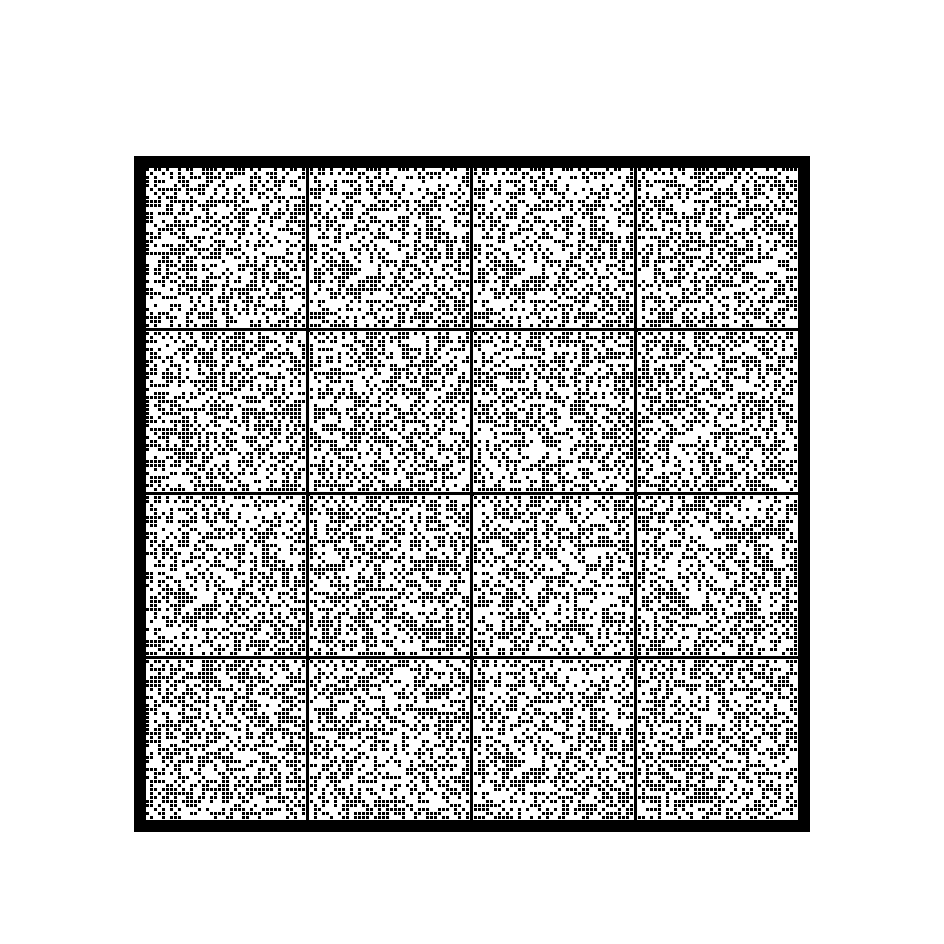
page 944x944 px, region at (118, 140) px, 177x177 dots, grid 4x4 cells
k=3 m=9 pages=1
This means a page of 944 × 944 px, a data area at (118, 140) px of 177 × 177 dots, and a
grid of 4 × 4 cells. Shards:k = ⌈270/128⌉ = 3 (the last one has 114 zero bytes of
padding), cap = 16 − 4 = 12, so m = 9, 1 page. (k, m) = (3, 9) → low rate,
T = 4, 3 chunks.
Superblock record (page 0):
50 42 52 55 01 01 0e 01 00 00 00 00 00 00 03 00
00 00 09 00 00 00 00 00 01 00 04 00 04 00 27 1c
f5 c8 52 0a f5 c4 55 b1 60 5d a9 76 ef 40 00 00
00 00 00 00 00 00 00 00 00 00 00 00 00 00 00 00
00 00 00 00 00 00 00 0b 53 50 45 43 20 73 61 6d
70 6c 65 00 00 00 00 00 00 00 00 00 00 00 00 00
00 00 00 00 00 00 00 00 00 00 00 00 00 00 00 00
00 00 00 00 00 00 00 00 00 00 00 00 00 00 00 00
That is: magic, version 1, flags 01 (compressed), stream length 270, k = 3, m = 9,
page 0 of 1, 4 × 4 cells, BLAKE3 prefix 271cf5c8520af5c455b1605da976ef40, KDF fields
zero, label length 11, SPEC sample.
Superblock block as printed (index = 0xFFFFFFFF, after whitening):
b4 b3 d3 a8 59 b5 6c 50 17 a1 40 0a c4 da 8b 62
f3 28 08 03 2a 29 79 00 a5 f6 1b 59 14 c4 e6 f9
ce 47 5a 60 60 82 09 c4 08 98 75 b3 09 e2 65 ae
9f a7 a5 63 f4 ae 9a 68 e6 00 5c 07 5a e9 83 97
88 2e 0d db 86 4d ed 92 2d a6 8b 2b 1e 4b 17 80
11 71 61 b6 e1 3b 44 f1 17 ab 03 09 0e 31 fb d8
26 83 ad 31 c6 3a a2 37 35 59 89 50 aa b7 94 91
60 e7 b7 4e c9 3d 8d 0c 17 e0 55 e4 75 6d f8 43
32 4c 74 f0 4a 5a 27 63 c3 e7 35 d0 f5 8f c5 c1
0f 21 ad ae 8d 4d 2d 7f db 54 d4 47 79 0a 2f 63
06 98 05 d9 ba b0 2b d8 78 ce 20 41 27 92 ef 19
69 5a a1 ae fe 03 83 3e 75 f1 54 ab 7e 8b 1a 90
73 4d 7b e7 d2 a6 18 ee
Parity shard k+0 (global index 3):
2a 92 69 9c 2b 0a b7 70 c4 a1 c0 89 54 56 bd fd
bb 03 d1 b8 ba cb 15 d4 ab 36 26 35 57 3f 48 6f
eb 29 25 d7 1f eb e5 6c 3e 46 22 da 0d 9e a1 db
97 4c e6 4b ba b5 ce 67 b2 82 c8 f7 12 bd 69 ef
0f d8 f5 8d ec da 39 f6 dd b9 ca a8 86 fd 8f df
24 36 90 74 fe 56 c5 8f 13 ea c0 1a 36 5b 67 33
bd ca 96 5a 75 a9 89 7b 59 57 ca 19 68 d9 83 1b
d9 d7 29 e3 d1 e7 0f dc 04 12 71 76 02 3b ba 8a
Cell contents (row-major, result of the shuffle of §6.4 with seed 0x1234ABCD;
SB = superblock copy):
11 SB SB 9
10 7 8 0
SB 6 5 2
3 4 SB 1
Rendered page: BLAKE3 of the raw 1-bit bitmap (rows of ⌈944/8⌉ = 118 bytes, MSB =
leftmost pixel, 1 = white) is
8770a1a05104398e54a7e892c04bca7208bdea6be4758f15b864de49e2de6a4c.
The PNG is docs/img/spec/sample-page.png, regenerated with
PABARU_SPEC_WRITE=1:
The image is informative. All 16 printed blocks are listed in
§11.4, and together with the STREAM above they
are enough to check a reader without the image. The test reads this bitmap back by
sampling pixel pad + ⌊size/2⌋ of every dot (§7.3). It decodes all
16 cells with the reference block decoder, checks the cell layout, the superblock and the
parity, recovers the 3 data shards from the 9 parity shards alone, and finally restores
hello.txt with Pabaru’s own scan decoder.
The 16 cells of the sample page (§10.7) as printed, i.e. after whitening, in row-major
order. These bytes are exactly what an ideal reader extracts from the image. They make the
sample independent of the PNG file: de-whiten, RS-decode and CRC-check each block, then
continue with §9 step 3. Each cell is labelled with its content (global shard index; data
shards are 0 ..= 2, parity shards 3 ..= 11, superblock copies SB).
Cell 0 (row 0, column 0): parity shard 11
b4 b3 d3 a8 ad 4a 93 af 93 91 a2 dd ec 39 a3 b8
e1 90 2a ec a1 67 31 34 cc 5f be 4a b3 42 29 26
4b 2c 80 97 10 92 8a ef f3 f9 fe c1 51 f6 57 cb
06 17 06 53 02 f6 57 de e1 45 c6 ef c1 0d 9b 89
cc c9 ab 65 cd 1f 27 f8 d8 d1 13 1e c3 2b 88 79
d3 40 6d aa 0f 70 ee 81 04 81 c0 34 72 4a 52 ae
d8 b1 5d 0d 83 ef 6f 10 11 ff c4 ec 84 1a 0c bb
e3 53 e2 1e b0 10 52 bb 97 7a c1 f6 95 b4 fb 09
9c 4d b7 20 94 36 f0 0c b9 e9 16 f6 bb 4b 0b 35
98 08 fb d8 74 66 c2 bf 97 fa 79 f0 e3 15 c2 c7
4f 14 bd 6d e9 00 14 b8 e8 20 23 8a 8a 5c a1 82
98 da d3 f2 5c 37 99 54 a6 f7 27 8c 02 1d 72 30
ce 2a 76 a2 ab c8 39 d5
Cell 1 (row 0, column 1): superblock copy
b4 b3 d3 a8 59 b5 6c 50 17 a1 40 0a c4 da 8b 62
f3 28 08 03 2a 29 79 00 a5 f6 1b 59 14 c4 e6 f9
ce 47 5a 60 60 82 09 c4 08 98 75 b3 09 e2 65 ae
9f a7 a5 63 f4 ae 9a 68 e6 00 5c 07 5a e9 83 97
88 2e 0d db 86 4d ed 92 2d a6 8b 2b 1e 4b 17 80
11 71 61 b6 e1 3b 44 f1 17 ab 03 09 0e 31 fb d8
26 83 ad 31 c6 3a a2 37 35 59 89 50 aa b7 94 91
60 e7 b7 4e c9 3d 8d 0c 17 e0 55 e4 75 6d f8 43
32 4c 74 f0 4a 5a 27 63 c3 e7 35 d0 f5 8f c5 c1
0f 21 ad ae 8d 4d 2d 7f db 54 d4 47 79 0a 2f 63
06 98 05 d9 ba b0 2b d8 78 ce 20 41 27 92 ef 19
69 5a a1 ae fe 03 83 3e 75 f1 54 ab 7e 8b 1a 90
73 4d 7b e7 d2 a6 18 ee
Cell 2 (row 0, column 2): superblock copy
b4 b3 d3 a8 59 b5 6c 50 17 a1 40 0a c4 da 8b 62
f3 28 08 03 2a 29 79 00 a5 f6 1b 59 14 c4 e6 f9
ce 47 5a 60 60 82 09 c4 08 98 75 b3 09 e2 65 ae
9f a7 a5 63 f4 ae 9a 68 e6 00 5c 07 5a e9 83 97
88 2e 0d db 86 4d ed 92 2d a6 8b 2b 1e 4b 17 80
11 71 61 b6 e1 3b 44 f1 17 ab 03 09 0e 31 fb d8
26 83 ad 31 c6 3a a2 37 35 59 89 50 aa b7 94 91
60 e7 b7 4e c9 3d 8d 0c 17 e0 55 e4 75 6d f8 43
32 4c 74 f0 4a 5a 27 63 c3 e7 35 d0 f5 8f c5 c1
0f 21 ad ae 8d 4d 2d 7f db 54 d4 47 79 0a 2f 63
06 98 05 d9 ba b0 2b d8 78 ce 20 41 27 92 ef 19
69 5a a1 ae fe 03 83 3e 75 f1 54 ab 7e 8b 1a 90
73 4d 7b e7 d2 a6 18 ee
Cell 3 (row 0, column 3): parity shard 9
b4 b3 d3 a8 af 4a 93 af 54 10 40 47 7c cb e4 af
c1 d0 94 b7 b1 f3 21 27 7b 82 2d eb 36 59 21 6b
1f b7 1e ab a8 39 9c 94 5e 13 da 50 4b ce 80 8f
96 a9 b7 82 b8 7f be 65 d3 aa 79 57 54 5f 32 e6
c0 63 eb 6a 05 a4 d2 2a 7d 06 fd ba 88 1c 2d 7a
00 ef 3a f4 de dd a5 23 22 0a 07 5f be 98 b7 37
39 f3 9a 2f 54 af 2c fa 62 b4 70 2b e2 85 67 df
65 9b c3 6e ac b1 be 1c 68 34 6a e0 1c 8c f1 d7
c0 07 0e 2a 0a b8 e0 0a 72 b9 3c 47 4b e7 5f 33
b6 b5 a2 77 c4 1a 44 1b 68 0b 3b 11 16 60 e4 38
7c d9 96 d1 65 4e bf 48 6b df 44 60 26 49 07 5a
ca 22 96 9d 17 94 ac ff 38 47 9a f6 26 ab 3f 9d
a0 90 d0 5c ee 76 38 68
Cell 4 (row 1, column 0): parity shard 10
b4 b3 d3 a8 ac 4a 93 af 8e 18 e1 49 5a ef 9a 04
38 57 9c 43 d0 f6 df ac 91 61 67 98 f3 79 76 4b
95 47 cd ca 2f cd 0e 2e a3 85 d9 ad 47 64 a4 90
e0 1e ee 86 f7 4e 4b 8f a1 d6 b3 e4 46 df d5 e0
8a 7c 8a dd aa aa 80 05 c7 2b a0 3c 56 3c 07 2b
f9 d8 a2 f4 d0 9f 21 50 79 e7 b3 82 ed 01 5e 9a
fe fc f4 be 8f 89 c8 ff fe d0 68 7a dc ae eb e8
c6 cb 4a 81 75 61 5f 57 7f 6a 0c 5d d5 2f fd d6
09 ce 9c f5 58 f6 99 64 65 4e 71 55 f5 77 2c 2b
09 9f cd 56 1e 0b 01 fa b9 6d 7e 26 fb 80 a9 b3
f9 b3 09 e4 64 fb 9e 59 69 98 28 26 a8 92 ab 83
79 b5 b1 36 7c 0d da 02 16 70 14 8d 19 b4 d4 8f
e1 c1 3e 2b ca f6 cb fd
Cell 5 (row 1, column 1): parity shard 7
b4 b3 d3 a8 a1 4a 93 af 85 e5 36 1d 6a 04 f7 80
e7 63 84 c2 bc 33 a1 f5 9e 81 57 69 95 20 ad 2b
99 e6 89 ad 1d 40 4f 13 e0 6b ec fe 68 87 0c 8f
95 b8 7f f0 c6 d7 b2 4d 05 0e ac 46 27 62 3c 6f
47 08 22 8b 0e 54 ac a1 5d f5 8d 3d b5 35 78 3f
b3 7a 48 98 ba 02 1e 50 35 77 44 1d cc 68 88 7e
72 16 51 52 77 55 73 eb d8 71 3d 47 25 b2 41 1a
d9 f8 58 1e 1c f5 0d 41 9f b5 cd 24 d0 c4 fe a2
7d 9e e0 b9 f1 d3 02 7e 3a fc cc 8b a6 51 1a 66
d5 67 f1 49 e8 f6 0b 0a cb 38 8c 51 e8 44 aa 27
14 60 b3 27 16 f5 55 e2 5d 70 39 98 f5 27 e2 b5
65 34 f9 54 15 56 80 c1 78 6a 29 62 5b 40 7f e7
36 7e 49 45 8e bf dd a3
Cell 6 (row 1, column 2): parity shard 8
b4 b3 d3 a8 ae 4a 93 af 2e eb f9 a6 97 f1 91 c4
37 95 5c 8f 41 c9 c0 1a 61 26 08 4b 59 7d 28 bf
8e 5b fb b9 00 de 9d 80 26 8a e6 38 6e c8 79 5b
61 24 f7 f5 94 72 77 5c f4 fe cd df f8 59 26 6d
1d dc 01 17 49 55 2d dd 10 28 1e b5 2b a8 7a ae
02 e6 bd 26 95 4d c8 0e 78 04 79 23 c2 f7 c8 b4
9a 98 f2 76 f5 e6 b8 fa 3d 5a e6 cc 8c cb 7c bd
98 7e 6d 07 af 48 15 16 48 32 e1 bc bb 85 f8 af
16 f5 04 08 70 8c fa 51 ba 7c 2a 15 96 7c 38 7f
bf 56 90 04 cb 29 49 10 20 9a 67 4d 8c 64 3e cb
c2 f0 c7 a5 9c a2 a3 be 00 d5 50 ae f4 39 ea c8
60 6d 1c 0a a9 44 46 58 54 e2 73 67 86 83 26 02
7a 7a 31 7f 77 f2 99 62
Cell 7 (row 1, column 3): data shard 0
b4 b3 d3 a8 a6 4a 93 af 6f 56 3d a2 c5 b3 a8 6b
f3 7a c5 2a 33 79 ad 03 c9 a1 65 0c 21 a1 57 cb
e5 dc df 68 14 07 be 1a 62 f3 14 36 d8 ee 70 8f
9a f6 6f 64 53 12 b3 f5 55 ca f3 08 b7 92 36 11
33 d5 36 27 06 b6 39 d4 f3 01 2a a5 ab bc 7c 4e
7c 8e 19 69 50 1d fb 40 5f b8 52 ce 35 b7 5e 37
f3 8e ab d2 9f a5 c9 2e 5c 64 52 93 3b 4e f3 0f
50 22 67 81 94 99 8a 64 74 cc 06 35 c6 a9 f0 3f
f0 aa 42 81 1b 0e a1 e7 81 52 b6 38 2f 3e d2 a7
71 c7 11 87 59 ed a9 0a e3 91 50 d5 41 a8 70 a0
63 25 b8 69 5b 12 60 d3 15 76 b0 14 db 24 fa 22
e4 dd d3 df cf 23 31 95 68 e3 5a 6f 1e 05 be da
fd 5f 81 07 25 30 ad e2
Cell 8 (row 2, column 0): superblock copy
b4 b3 d3 a8 59 b5 6c 50 17 a1 40 0a c4 da 8b 62
f3 28 08 03 2a 29 79 00 a5 f6 1b 59 14 c4 e6 f9
ce 47 5a 60 60 82 09 c4 08 98 75 b3 09 e2 65 ae
9f a7 a5 63 f4 ae 9a 68 e6 00 5c 07 5a e9 83 97
88 2e 0d db 86 4d ed 92 2d a6 8b 2b 1e 4b 17 80
11 71 61 b6 e1 3b 44 f1 17 ab 03 09 0e 31 fb d8
26 83 ad 31 c6 3a a2 37 35 59 89 50 aa b7 94 91
60 e7 b7 4e c9 3d 8d 0c 17 e0 55 e4 75 6d f8 43
32 4c 74 f0 4a 5a 27 63 c3 e7 35 d0 f5 8f c5 c1
0f 21 ad ae 8d 4d 2d 7f db 54 d4 47 79 0a 2f 63
06 98 05 d9 ba b0 2b d8 78 ce 20 41 27 92 ef 19
69 5a a1 ae fe 03 83 3e 75 f1 54 ab 7e 8b 1a 90
73 4d 7b e7 d2 a6 18 ee
Cell 9 (row 2, column 1): parity shard 6
b4 b3 d3 a8 a0 4a 93 af eb 18 91 45 48 57 bb cd
ab cd 87 3a af d4 71 11 8d 05 eb 96 57 37 c7 8b
59 57 8b 49 5e a6 24 e6 4f 3b 3b 27 c1 4a e0 37
50 2c c5 bb 0c 29 d7 3f 33 76 74 da d2 1c e2 74
db 83 dd 4c 53 0a d1 47 b1 04 4c a0 d9 fb 47 29
10 ab 26 7f f9 af a2 c1 36 fd ff 84 c5 7e db 72
08 ea c8 ec 2b 4d 65 0c 04 85 1f 42 e7 9e 47 d3
48 f3 98 81 4f fd 11 28 7a 9c 03 4e 7c 0f f9 ee
9f d3 d7 46 98 6a e3 42 96 75 08 49 3c 4b bc 01
36 89 cd 19 9b 25 9b 3f 3f 44 75 bd 1c d1 e7 a6
bd 6e 26 ea 31 5b 37 13 7f f6 1b 53 30 af b6 de
07 84 57 bd 3d b6 b9 4c fe 0a f3 98 08 3b a4 a2
04 0f f4 6e 0f e7 62 91
Cell 10 (row 2, column 2): parity shard 5
b4 b3 d3 a8 a3 4a 93 af 63 5e a6 57 85 21 9d 05
a4 5d 8a df 27 bb b9 a4 11 15 f3 10 c8 56 28 4d
68 d0 3c 32 01 30 27 8a 55 97 37 3d cc 2e 7d 6c
b4 1a bf b9 27 e9 c2 71 d5 94 a5 ee 81 e1 a4 7f
f7 d8 6d 7a 30 0e a8 d9 b8 a0 53 a7 11 98 51 69
d5 3a 04 31 2d 28 95 43 0f 61 01 e2 d1 0e e8 b3
b9 83 c8 c7 08 bd 7e 10 ae 32 4a 37 26 02 b7 18
26 83 6f c8 c8 70 5c 01 2e e8 bd 7e a1 61 f4 eb
42 0e 79 ca e1 44 06 f3 c6 c4 40 35 00 93 05 78
c0 0b 5d 4c 52 dc 20 fc 81 54 e5 61 4c 24 c0 fd
19 5a 3b fc aa 99 79 af f1 49 67 cb 09 39 5f 0b
b2 f3 8d 42 e8 6e 44 8c 2b 68 34 e2 05 d1 b3 7c
9b 52 85 93 48 05 23 19
Cell 11 (row 2, column 3): data shard 2
b4 b3 d3 a8 a4 4a 93 af 42 31 18 9f 9e c0 47 f1
bf c8 52 d7 1f 28 7a 00 a5 f6 12 59 14 c4 e6 f9
cf 47 5e 60 64 82 2e d8 fd 50 27 b9 fc 26 30 1f
ff fa 0c 15 1b ee 9a 68 e6 00 5c 07 5a e9 83 97
88 2e 0d db 86 4d ed 92 2d a6 8b 2b 1e 4b 17 8b
42 21 24 f5 c1 48 25 9c 67 c7 66 09 0e 31 fb d8
26 83 ad 31 c6 3a a2 37 35 59 89 50 aa b7 94 91
60 e7 b7 4e c9 3d 8d 0c 17 e0 55 e4 75 6d f8 43
32 4c 74 f0 4a 5a 27 63 38 e1 5c 4c b7 de f4 1e
0d 08 ef 54 fc 7e 8b 18 33 ef 5f 49 c0 4a 59 35
ac be 30 c6 cb ab 91 e5 bf 25 89 41 19 d6 6d 6a
99 46 65 17 1e 22 f7 24 71 dc 23 a9 78 21 bf eb
50 6b 67 a7 97 44 5a 0b
Cell 12 (row 3, column 0): parity shard 3
b4 b3 d3 a8 a5 4a 93 af 6d 71 7b c3 ee d1 32 13
37 89 c8 8a 7e 7f c7 fd 1e f5 c3 e1 ae 0f f3 2d
64 71 78 55 33 bd 66 b7 16 79 02 6e e3 cd d5 73
c1 bc 2e cf 16 70 3b b3 71 4c ba 4c e0 5c 4d f0
3a ac c5 2c 94 f0 84 7d 22 7e 7e a6 f2 91 2e 7d
9f 98 ee 5d 47 b5 aa 43 43 f1 f6 7d f0 67 3e 57
35 69 6d 2b f0 61 c5 04 88 93 1f 0a df 1e 1d ea
39 b0 7d 57 a1 e4 0e 17 ce 37 7c 07 a4 8a f7 9f
36 5e 05 86 48 61 9d e9 94 4f 8d 86 3a 8c 34 09
4c a0 e2 1a de d6 79 45 d9 58 df 46 9b 3b a7 c2
6f 53 fa 7f 5f 57 f2 5d 6c 44 6d 36 dd a3 f5 cf
7c 98 c2 6a d3 38 03 10 17 2a 85 17 a7 d9 99 18
f4 fb 0d 4b 80 4c c8 14
Cell 13 (row 3, column 1): parity shard 4
b4 b3 d3 a8 a2 4a 93 af 94 31 22 64 f8 76 0c 34
11 68 15 d6 6a ef 90 2c 97 a1 ce 36 38 13 ce 5f
c8 bb 6e 5b f6 41 25 f2 37 a2 07 4f e4 4c 19 e3
a7 a1 85 cc 20 24 1e 06 14 22 c0 52 7e 1a f6 ff
06 3c 37 31 1f fb 2e b0 dc 2a af af 7a 4f 10 fd
12 a2 a1 ad b2 3f cf ec 6c f3 81 f8 b9 11 a4 f1
ab 81 a0 b5 8a 04 f1 0c 5b 6b 89 a5 89 d0 5c b1
b5 16 36 e8 4c 04 ba 22 5a 9a 88 12 db 06 f0 96
49 21 dd 64 e2 5e f9 19 68 80 e7 53 26 e3 50 d9
03 ee cc be 2d 5e 47 0f 80 4c af ca 20 26 a4 e3
53 ab 2c 66 3b 95 a9 88 59 5d 32 d8 45 10 64 9a
7c ff 1c 21 52 f6 f4 c0 1c 60 c3 5f 5c ea 59 5f
77 37 8d 44 de f1 27 65
Cell 14 (row 3, column 2): superblock copy
b4 b3 d3 a8 59 b5 6c 50 17 a1 40 0a c4 da 8b 62
f3 28 08 03 2a 29 79 00 a5 f6 1b 59 14 c4 e6 f9
ce 47 5a 60 60 82 09 c4 08 98 75 b3 09 e2 65 ae
9f a7 a5 63 f4 ae 9a 68 e6 00 5c 07 5a e9 83 97
88 2e 0d db 86 4d ed 92 2d a6 8b 2b 1e 4b 17 80
11 71 61 b6 e1 3b 44 f1 17 ab 03 09 0e 31 fb d8
26 83 ad 31 c6 3a a2 37 35 59 89 50 aa b7 94 91
60 e7 b7 4e c9 3d 8d 0c 17 e0 55 e4 75 6d f8 43
32 4c 74 f0 4a 5a 27 63 c3 e7 35 d0 f5 8f c5 c1
0f 21 ad ae 8d 4d 2d 7f db 54 d4 47 79 0a 2f 63
06 98 05 d9 ba b0 2b d8 78 ce 20 41 27 92 ef 19
69 5a a1 ae fe 03 83 3e 75 f1 54 ab 7e 8b 1a 90
73 4d 7b e7 d2 a6 18 ee
Cell 15 (row 3, column 3): data shard 1
b4 b3 d3 a8 a7 4a 93 af 1b 82 59 d7 45 79 72 16
96 eb 4f 47 9a 87 32 67 dc e5 70 5d 28 dc 85 7f
78 91 7e 1d 8e 6d fe 33 59 84 1d 0d d2 0b 21 44
18 dd be 65 4e 86 83 0e d6 46 58 22 7a 29 cb 15
23 1e 74 0c ee b9 ea 87 04 f1 e4 ab eb 01 54 8e
34 25 74 d7 71 10 a9 6d 49 26 db 2d 68 b1 f7 50
dc 0f 66 67 c6 30 e6 3a 25 2b 91 49 ac 1c 42 9f
b2 f4 db 77 fe f4 73 78 b4 15 4c 10 64 4b fa 33
52 08 34 ef c8 1f 20 a6 74 c7 b0 83 bf 0f a0 67
f6 23 8c ee 72 15 75 e9 8d 1b 41 be 2e 88 82 d6
5e fb fc a9 f4 41 53 d1 39 32 fd 0f fa 51 96 5d
7f ed 86 65 05 74 18 17 63 3c 51 ab 3e 8e 05 cc
7a d3 32 d4 24 c3 4c c0
This page is generated from docs/SPEC.md in the Pabaru repository.